Preventative Medicine in China
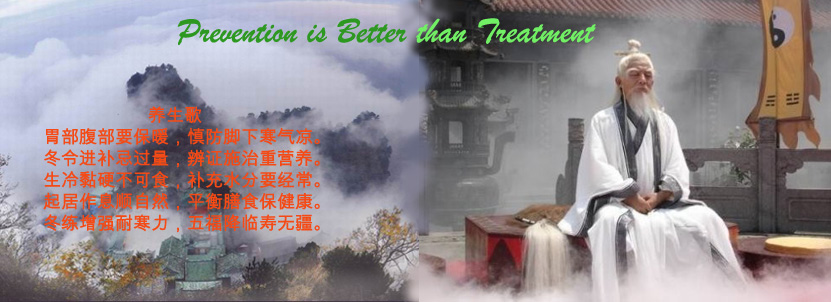
The Chinese system of medicine suggests that health is achieved and disease prevented by maintaining the body in a balanced state; this concept could be applied both to individuals and to society as a whole. In individual terms, ancient Chinese physicians preached moderation in all things, such as food and alcohol, and also suggested that normal activities should include mental, as well as physical tasks.
In Chinese history, the wealthier Chinese and VIPs always liked to visit their doctor even when they were well, paying a retainer to the doctor as long as they kept them healthy; if they became ill and the illness could not be cured quickly, the doctor would lose his fee. Such a highly sophisticated and personal system of health care, in somebody's opinion, may be impractical within our current social and economic environment. But the concept behind these ideas represents the first coherent disease prevention system, designed for the individual.
The cornerstone of health, within the context of traditional Chinese medicine, is a normal fluctuating balance of Yin and Yang. If such balance ceases to exist, then the Chinese believe that external pathogens could invade the body and cause diseases.
The essential principle of traditional Chinese medicine is to specify the exact nature of the imbalance between Yin and Yang, and the pathogen causing the trouble; and then to select the appropriate therapies, such as food therapy, herbal remedy, acupuncture or even sport therapy ( e.g. Taiji ) to correct these pathological processes. As the nature forces of the body become balanced, the disease will be eliminated.
Since, in most of cases, the imbalance of Yin and Yang has existed for a while before a disease happens, it therefore can be considered as a warning of a disease. The art of traditional Chinese preventative medicine is to fix this imbalance accurately in the early stage so that a disease then can be prevented.