| ||
|
|
|
What Is Acupuncture?
Acupuncture (the insertion of very fine needles to promote the flow of energy within the
body) is a balancing technique purported to restore the body to optimal health.
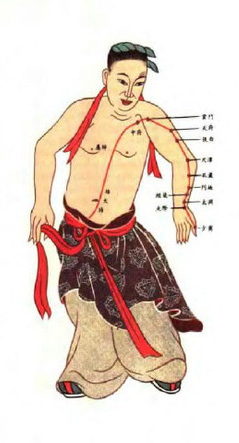
The classical Chinese explanation is that channels of energy run in regular patterns
through the body and over its surface. These channels, called meridians, are like rivers
flowing through the body to irrigate and nourish the tissues, blood flow and nervous pulses
also follow meridians to run through the body to various parts, structures and organs. An
obstruction in the movement of these energy rivers are like a dam that backs up the flow
in one part of the body and restricts it in others. Any obstruction and blockages or deficiencies
of energy, blood and nervous pulses would eventually lead to disease.
Needling the acupuncture points can influence the meridians: the acupuncture needles
unblock the obstruction at the dams, and reestablish the regular flow through the meridians.
Acupuncture treatments can therefore help the body's internal organs to correct imbalances
in their digestion, absorption, and energy production activities, and in the circulation of
their energy through the meridians.
According to the needling methods, acupuncture can be divided into traditional acupuncture, ear
acupuncture, electro-acupuncture, scalp acupuncture and hand acupuncture etc. Over the last
few decades, traditional acupuncture was widely used combining with other techniques, like
moxi-needling, cup-needling etc, to increase the therapeutic effects.
Modern science explain the functions of acupuncture as following:
Needling the acupuncture points stimulates the nervous system to release chemicals in the
muscles, spinal cord, and brain. These chemicals will either change the experience of pain,
or they will trigger the release of other chemicals and hormones, which influence the body's
own internal regulating system. What Kinds of Diseases Can Be Treated by Acupuncture?
Brain
imaging suggests acupuncture works, study says (CNN News) (01-Dec-99)
The following conditions have been recognized by the World Health Organization (WHO) as treatable by ACUPUNCTURE:
Much more conditions and diseases can be treated or cured by the Traditional Chinese Medicine.
Does Acupuncture Hurt?
The sensation experienced by the patient with acupuncture is largely subjective and may be quite variable.
Needling sensation is not painful, but it is a dull, bursting or numb feeling around the
site of the inserted needle. Occasionally sensations may travel up and down the channel
on which the acupuncture point is situated; for example, the stimulation of an acupuncture
point on the left leg may precipitate a strange warm or numb sensation in the right
shoulder.
Acupuncture needling sensation is probably best defined by some patient's statement:
"When needling sensation is experienced, the needle no longer feels like a needle!"
How long an acupuncture treatment takes? How many visits required? and What the patient's response to treatment is?
Each treatment takes about an hour. Acupuncture is usually given in a series of treatments.
Since each person is unique, the number of treatments will vary. The determining factors
include the type of conditions, whether the conditions is chronic or acute, and the
individual response to the treatment.
It is almost impossible to predict how a patient will respond to acupuncture. Very
occasionally, one treatment is all that is required, whereas other people may need a number
of treatments to gain the same result for the same disease. In general most people,
and their problems, do not respond magically to one treatment, and between 5 and 10 teatment
sessions may be required in order to obtain the best results from acupuncture.
Acupuncture usually works in stages. The first 2 or 3 treatments represent a process of
"understanding the needs of the patient", and are therefore a sort of experiment designed
to assess the specific requirements for that person in that particular condition. Some
people respond to classical body or ear acupuncture, whereas others respond better to
acupuncture with electricity or moxabition. This partially reflects the skill of the
acupuncturist in the use of specific techniques, but it also represents the fact that
the body responds in a slightly different way to different stimuli.
If there has been no response to treatment after the first 5 sessions, then it is doubtful
whether any response will occur. However, sometimes improvement may be very delayed and
symptoms may not clear until the treatment ceased. Occasionally patients who have been
abandoned, with no improvement after three weeks, will suddenly find improvement some weeks
after cessation of acupuncture.
Although in China acupuncture is given daily, acupuncturists in the West tend to treat people
on a weekly basis. After 10 years of practice in the West, we notice that the best plan is twice
treatments in the first 2 weeks then followed by weekly basis.
Many clinical reports claim that acupuncture can have a curative effect in the treatment of
conditions like acute injuries, but there is no evidence to support that acupuncture can
reverse the damaged structure, like osteoarthritis, to normal. Although majority of patients
get a long-term relief of the symptoms after acupuncture, it doesn't mean that their bodies
have already gone back to normal, the problems they suffered before will possible recur later
on. The traditional Chinese approach is to attempt to maintain the patient in a state of
health, and regular one-monthly treatment patterns for those who with chronic problems, like
osteoarthritis, may therefore be justified. However, for most people who with non-chronic
conditions, we usually treat them when symptoms recur.
Sometimes the patient may experience a temporary worsening of symptoms due to acupuncture;
this response to treatment and in general is a good sign, usually only lasting for a day or
two and being followed by improvement.
After an initial evaluation the acupuncturist should provide you
with a treatment plan that includes the modalities to be used as well as the frequency
and duration of treatment.
What kinds of needles are used? Is acupuncture safe?
Extremely fine stainless steel needles are used. To avoid the risk of transmission of
contagious disease, all needles are pre-sterilized and pre-packaged by the manufacturer,
and disposable after being used.
Unlike injection, there is no medicine on the acupuncture needles. The acupuncture aims to stimulate
one's own internal healing power, it is unlikely to cause any side effects as the medication.
Therefore, it is a particularly safe form of therapy.
Many people, when learning acupuncture, are very worried about the fact that needles may penetrate
nerves or organs to cause paralyse and serious damage. However, this possability is very
little because a well qualified acupuncturist has good knowledge of anatomy and good needling
technique to avoid this potential hazard. Occasionally a small amount of bleeding at the
site of needled insertion does occur, then a small local bruise can result, but these are
not dangerous and never been reported as adverse reactions. The use of an electro-acupuncture
is contraindicated if the patient has a cardiac pacemaker, because it may either switch off
the pacemaker or drive it at a dangerous rate.
In conclusion, acupuncture is a very safe procedure, providing the practitioner has
well training and experience. Over the last 24 years of practice, we have never seen any
damage caused by acupuncture. All the serious acupuncture adverse reactions reported by the
literature are due to inadequate training, thoughtlessness or incompetence of the
practioners. For the safety of the general public, the College of TCM and Acupuncture of
B.C. advises you to seek out a licensed registrant. To find out a licensed registrant in your
city, you can go to www.ctcma.bc.ca or call
the College of Traditional Chinese Medicine Practitioners and Acupuncturists of British
Columbia (CTCMA) at (604) 638-3108.
CNN
Traditional Western medicine has been skeptical of the benefits
of acupuncture, but researchers in New Jersey say that evidence
derived from brain imaging shows the treatment helps to relieve
pain.
Back home